

You know what you should do.
You’ve set the goal a dozen times. Maybe it’s the gym membership. The meal prep. The side project. The thing you keep saying you’ll start “next Monday.”
And yet... you don’t do it.
Or you start strong on Monday and peter out by Thursday. The momentum dies. The excuses multiply. The self-criticism starts.
I didn’t do enough.
I’m not good at this.
Why even bother?
What’s going on? Why can’t you just do the thing?
Here’s what most people miss: Behavior change isn’t a willpower problem. It’s a sales problem.
And you’re losing the deal with yourself every single day.
The Voice in Your Head is a Negotiation
Think about the last time you tried to talk yourself into doing something hard.
Going to the gym after work. Saying no to that third slice of pizza. Sitting down to read instead of scrolling.
That resistance you felt? That’s not weakness. That’s your brain doing what it’s designed to do: negotiate.
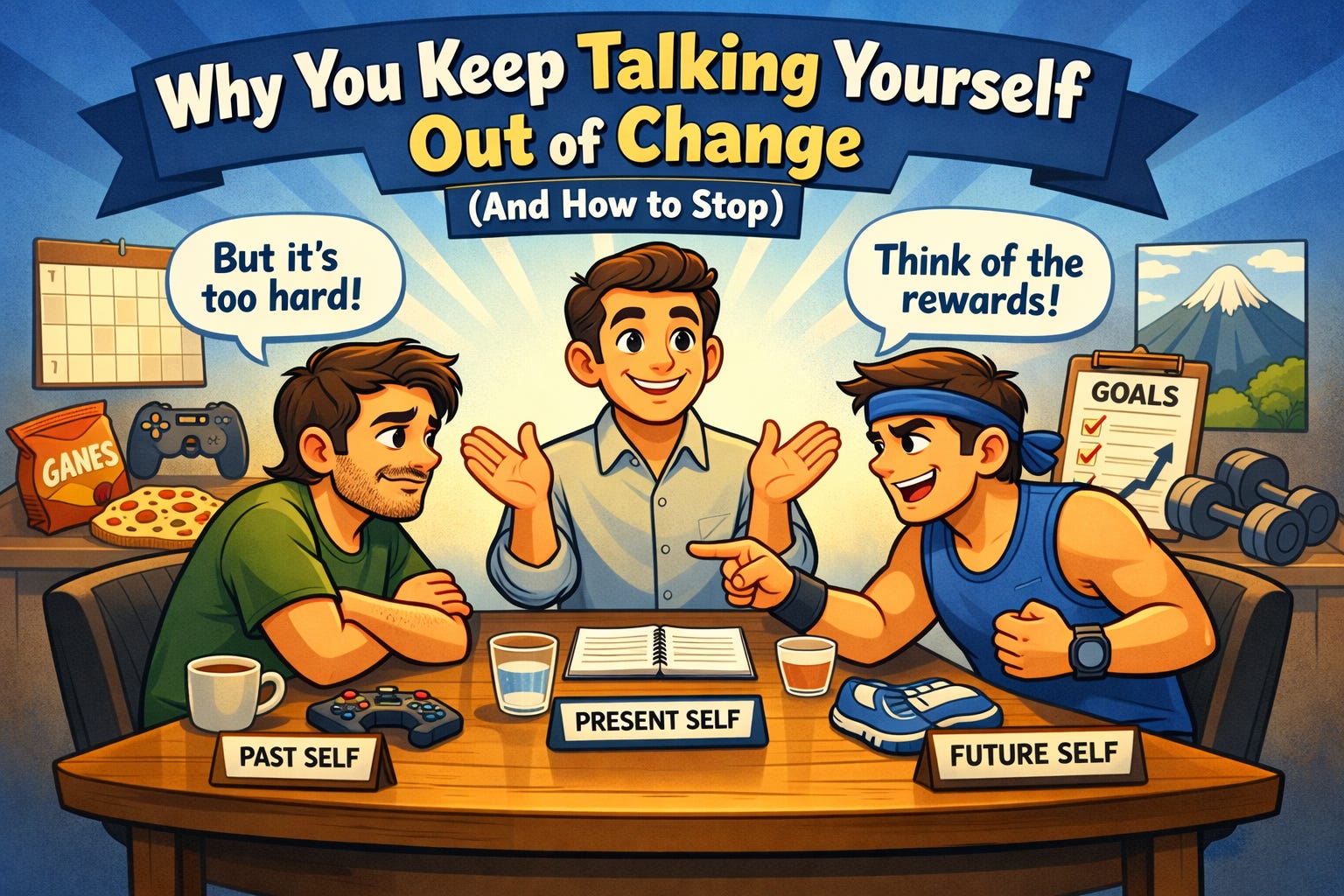
One part of you wants the change. The future version who’s in shape, productive, successful.
Another part of you wants to stay exactly where you are. The version who’s tired, comfortable, risk-averse.
And right now—in this moment—you’re caught in the middle, trying to broker a deal between who you were and who you’re becoming.
The problem is, you don’t realize you’re in a negotiation.
So when that voice says, “I’m too tired,” or “I didn’t do enough today,” or “I’ll never be good at this,” you accept it as fact.
You wouldn’t do it with a friend. But with yourself? You believe every objection without question.
What Sales Teaches Us About Change
I had a conversation recently with a client—a realtor. Smart woman. Great at her job.
She knows how to handle objections. A buyer says, “It’s too expensive,” and she doesn’t panic. She digs deeper. What are they really saying? What’s the actual concern? She reframes. She shows value. She finds the win.
But when it comes to herself? When that voice in her head says, “I didn’t do enough today”?
She believes it. Spirals into it. Beats herself up over it.
I asked her: “What do you do when someone shares an objection with you?”
She paused. “Well... I address it. I help them look at it differently.”
Exactly.
Your negative thoughts aren’t facts. They’re objections. And you already know how to handle objections.
You do it at work. You do it with your kids when they don’t want to do homework. You do it with friends when they’re being too hard on themselves.
You’re an expert at helping other people change their minds.
You just never turned those skills on yourself.
The Three Moves That Change Everything
Here’s the framework. It’s simple, but it works.
Move 1: Recognize the Objection
The first step is noticing when your brain is negotiating with you.
“I’m too tired.”
“I don’t have time.”
“I’m not good enough.”
These aren’t truths. They’re resistance.
Your brain is protecting you from discomfort. From failure. From the unknown. That’s its job.
But here’s the thing: trying NOT to think something makes you think it more.
When I was seven, I snuck a viewing of the movie Psycho. That shower scene messed me up. For months, I couldn’t sleep. I’d lie in my dark room, telling myself not to be scared. There’s nothing scary. Don’t think about scary things.
And you know what happened? The more I told myself not to be scared, the more scary things I saw. The crack in my closet door became a creature. The pile of clothes in the corner became a figure sitting there.
My brain was doing exactly what I told it to: look for scary things so you can avoid them.
The same thing happens when you tell yourself, “Don’t have negative thoughts.”
Your brain flags it. Searches for it. Proves it to you over and over.
So step one isn’t to suppress the objection. It’s to notice it.
Oh, there’s that voice again. The one that says I didn’t do enough.
That’s it. Just notice.
Move 2: Address It (Don’t Dismiss or Spiral)
Now here’s where most people go wrong.
They either:
Dismiss it entirely (“Stop being negative!”)
Spiral into it (“You’re right, I’m terrible, why even try?”)
Both are dead ends.
Instead, shift the story. Acknowledge the concern. Then reframe with evidence.
The objection: “I didn’t do enough today.”
The reframe: “What DID I do today?”
Maybe you didn’t crush a full workout. But you did ten minutes of stretching. You took the stairs. You chose the salad over the fries.
That’s something.
I had another client recently. Her goal was to not eat out all week. She nailed it—seven days, no restaurants.
But then Super Bowl happened. She snacked more than she’d planned. And immediately, she started beating herself up.
I failed. I have no discipline.
I asked her: “Did you snack more than you planned, or more than you normally would have?”
She paused. “...Less than I normally would have.”
Exactly.
She didn’t fail. She made progress.
But she was so focused on the gap between perfect and reality that she couldn’t see it.
When you address the objection, you’re not lying to yourself. You’re giving yourself the same fair assessment you’d give someone you care about.
Move 3: Close on Today
Here’s the final piece: make the ask small and specific.
Not “I’m going to work out every day forever.”
Just: Can I do something today?
Ten minutes on the bike. A walk around the block. A few exercises before bed.
You’re not trying to close the deal on your entire future self. You’re trying to close on one small yes.
And then tomorrow, you ask again.
Because here’s what happens when you stack small yeses: they compound.
Each one builds belief. Each one makes the next one easier. Each one shifts your identity from “someone who talks about it” to “someone who does it.”
I asked one client recently if she could aim for something physically active—anything—every single day until we talked again.
She hesitated. Every single day?
I didn’t put a time limit on it. Could be ten minutes. Could be the bike at the gym. Could be yoga at home.
Just: something. Every day.
Not overwhelming or vague. A clear action you can take today.
Your Present Self is The Broker
Imagine yourself as a mediator in a negotiation.
On one side: the past version of you. The one with objections, fears, established patterns. The one who’s comfortable where things are.
On the other side: the future version of you. The one with different habits, capabilities, confidence. The one you’re working toward.
Your job right now—in this moment—isn’t to be that future person. Not yet.
Your job is to broker the deal between who you were and who you’re becoming.
One small agreement at a time.
You’re the realtor. You’re the mediator. You’re the person in the middle who knows both sides and helps them find common ground.
And the way you do that? By addressing objections. By reframing concerns. By finding the win-win.
Your First Sale
If you’ve been stuck—if you’ve been talking yourself out of change—I want you to try something this week.
When that voice shows up (and it will), I want you to:
Notice the objection. Don’t suppress it. Just recognize it for what it is.
Address it. What DID you do? How does that compare to your past self?
Close on today. Not forever. Just today. What’s one small yes you can give yourself?
That’s it.
One objection. One reframe. One yes.
You already have the skills. You just need to start using them on the person who matters most.
Yourself.
~ Coach Alex
If this hit home and you’re ready to stop negotiating with yourself and start making real progress, reply to this email. Let’s talk about what’s actually holding you back—and how to move past it.